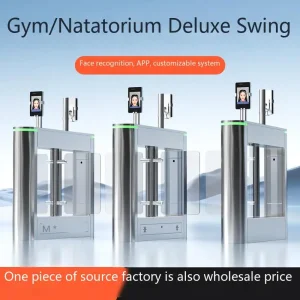
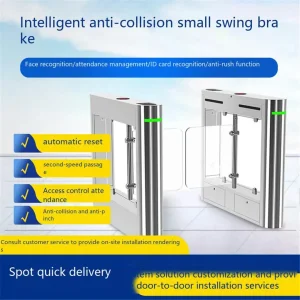
Enterprise Gateways & Biometric-Enabled Hardware
Pre-engineered access control turnstiles, automated barriers, and automated recognition terminals directly integrated with industrial biometric logic.

Global Fingerprint Technology Status & Cost Architecture
Analysis of production volume scaling, supply-chain localization in Shenzhen, and raw sensor fabrication costs across major access control categories.
Achieved through integrated CMOS active-pixel sensor scaling over 5 fiscal cycles.
Strict threshold matching on modern FIPS-201 and PIV-certified algorithm stacks.
Hardware-accelerated edge template matching on ARM Cortex-M4/A53 SOC units.
Global field-tested deployments including harsh environmental sites across 5 continents.
| Sensor Architecture | Unit Cost Tier (OEM) | Typical Volume Price | Spoof Detection (PAD) | MTBF / Durability | Ideal Industrial Application |
|---|---|---|---|---|---|
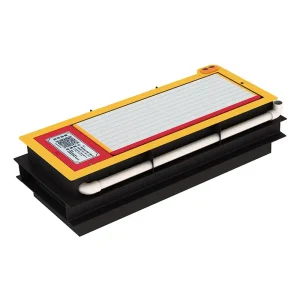
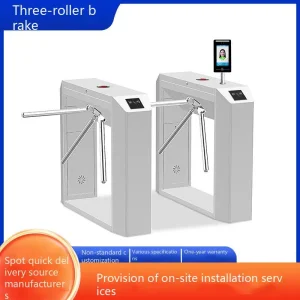
| Optical TIR Prism (500 DPI) | Tier 1: Economy | $4.50 – $12.00 | Baseline (Static Image) | > 1,000,000 rubs | Commercial attendance, turnstile gates, gym access |
| Capacitive / Silicon Active Pixel | Tier 2: Mid-Range | $8.00 – $22.00 | Conductivity + Capacitance | > 500,000 rubs | Enterprise locks, safe deposit, handheld terminals |
| Multispectral Surface/Subsurface | Tier 3: Enterprise | $45.00 – $95.00 | High (Liveness & Hemoglobin) | > 2,500,000 rubs | Border crossings, banking vaults, critical infrastructure |
| Ultrasonic 3D In-Glass Matrix | Tier 4: Specialized | $35.00 – $80.00 | Deep 3D Ridge Acoustic Profile | Ruggedized (Protected glass) | Outdoor toll-gates, marine wet environments, medical |
Industrial Evolution: From Surface Scans to Multispectral Edge AI
Key technological breakthroughs driving lower acquisition prices alongside enterprise-grade cryptographic reliability.
Edge-Native Neural Extraction
Micro-NPU chips embedded within turnstile and gate controllers perform local minutiae extraction and template matching without transmitting raw biometric images across public networks, radically decreasing server compute costs.
ISO/IEC 19794-2 CompliantHardware Root of Trust & Anti-Spoofing
Modern low-cost optical scanners now incorporate dual-spectrum liveness detection (PAD) certified under ISO 30107-3, preventing attacks executed via gelatin molds, latex film, or ultra-high-resolution 3D resin prints.
FIDO2 & Common CriteriaTouchless Wave Capture
Four-finger optical sweep technology without platen contact is entering cost-parity with traditional contact silicon sensors, enabling sanitary high-throughput pedestrian passage in commercial lobbies and hospitals.
Zero Maintenance PlatensLocalized Industry Deployments & System Topologies
Biometric authentication tailored to unique physical access, environmental parameters, and operational constraints.
Industrial Manufacturing & Processing
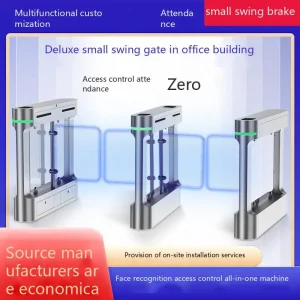
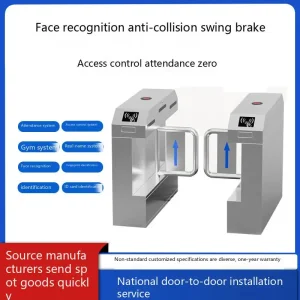
Factory environments demand ruggedized IP65-rated optical modules able to read worn, dry, oily, or chemical-stained hands without elevating the False Rejection Rate (FRR). Systems integrate directly with swing gates for attendance auditing.
IP65 / IK08 RatedUnattended Residential & Mixed Parking
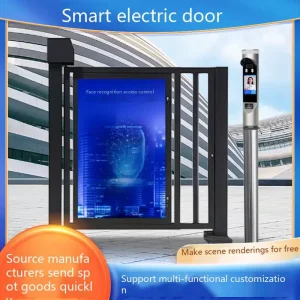
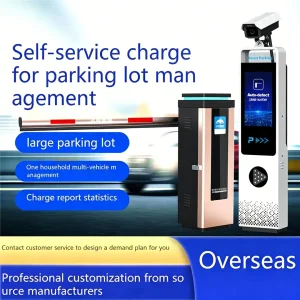
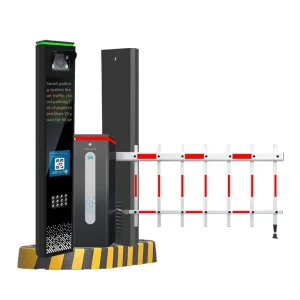
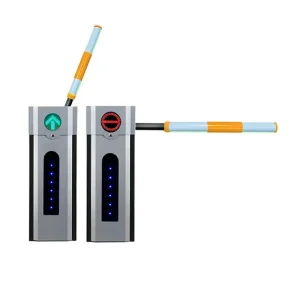
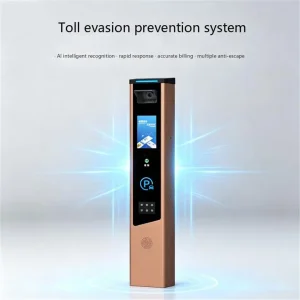
Integrated vehicle barrier systems pair license plate recognition (LPR) cameras with pedestal-mounted capacitive fingerprint scanners for dual-factor tenant validation during automated entry without RFID card loss vulnerabilities.
Dual-Factor VerificationHigh-Security Plazas & Perimeter Defense
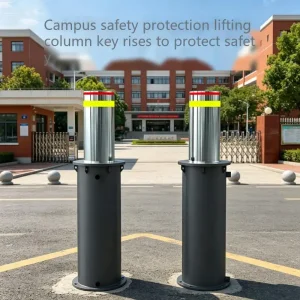
Automated hydraulic bollards and heavy-duty speed gates paired with multispectral fingerprint units guarantee non-repudiation logging for military zones, data centers, government administration buildings, and secure treasury banks.
Anti-Tailgating ArchitectureEngineering Roadmap & Biometric Technology Outlook
A multi-year progression toward autonomous, encrypted, and decentralized access hardware platforms.
Phase I: Hardware Micro-Miniaturization & All-in-One SoCs
Consolidation of image capture, cryptographic template storage, and CAN/RS-485/Wiegand network processing onto single silicon chipsets, reducing module production overhead by 30% while mitigating physical bus probing attacks.
Phase II: Quantum-Safe Template Encryption & Privacy Compliance
Implementation of lattice-based post-quantum cryptography on-chip. Biometric vectors are permanently transformed into one-way cancelable templates, fully satisfying GDPR, CCPA, and PIPL privacy frameworks across cross-border installations.
Phase III: Multi-Modal Sensor Fusion at the Edge
Unified access control portals combining sub-dermal fingerprint reading, embedded 3D facial depth mapping, and dynamic LPR in unified cloud-managed edge appliances for near-zero latency and fail-safe authentication.
Enterprise Sourcing & TCO Evaluation Guidelines
A rigorous engineering framework for evaluating industrial equipment suppliers beyond the unit sticker price.
Sensor Platen Longevity
Uncoated cheap optical glass deteriorates rapidly in coastal or public environments. Evaluate suppliers offering high-hardness optical crowns (>7 Mohs) or chemical-resistant capacitive coatings.
BOM Audit EssentialSDK & Firmware Stack
Verify whether the manufacturer supplies royalty-free SDKs with standard C++, Java, and REST API support, along with native Linux/Android ARM compilation pipelines to prevent integration lock-in.
Zero Royalty TermsSupply Chain Continuity
Opt for tier-one Shenzhen-based manufacturers with vertically integrated CNC machining, surface mount assembly (SMT), and cleanroom optical bonding to safeguard 7–10 year parts availability.
Factory-Direct DirectField Replacement Unit (FRU)
Ensure that biometric sensor modules, barrier motors, and control boards operate as modular plug-and-play field units, minimizing site downtime and avoiding entire cabinet de-installations.
Rapid MTTR ProtocolFrequently Asked Questions (FAQ)
In-depth responses to critical technical and logistical questions faced by global security distributors, EPC contractors, and integrators.
What is the actual production cost breakdown of an industrial fingerprint module?
Typically, raw optical components or capacitive silicon dies constitute 40-50% of the bill of materials (BOM). The remaining cost comprises the micro-controller/DSP unit (20-25%), protective sapphire/glass housing and platen coatings (15%), and intellectual property licensing for onboard matching algorithms (10-15%). Factory-direct volume procurement in Shenzhen captures economies of scale, often lowering unit acquisition by 35-45% compared to regional distribution markups.
How does outdoor environmental exposure affect operational accuracy and pricing?
Unconditioned outdoor environments require IP65 or IP67 sealing, operating temperature ranges between -20°C and +65°C, and integrated heating elements to prevent condensation. This industrialization adds roughly $15 to $35 per terminal unit but prevents catastrophic field degradation, false rejection surges from sunlight saturation, and prism clouding.
Can fingerprint technology integrate seamlessly with automated barrier and turnstile systems?
Yes. Biometric modules feed identity decisions directly into edge controllers via encrypted Wiegand, RS-485 OSDP v2, or Ethernet IP interfaces. Once verified, the controller triggers dry-contact or transistor relays to cycle turnstiles, lift boom gates, or retract hydraulic bollards within 200 milliseconds, ensuring uninterrupted pedestrian and vehicular flow.
What minimum certifications must be specified for enterprise border or commercial security?
For municipal, government, and high-security enterprise installations, mandate FBI PIV (Personal Identity Verification) or Mobile ID (FAP 10/20/30) standards, alongside ISO/IEC 19794-2/4 for minutiae layout. Furthermore, insist on ISO 30107 Presentation Attack Detection (PAD) compliance to eliminate silicon molding and spoofing risks.
How are international privacy regulations addressed during edge biometric storage?
Compliant systems never save actual raw photographic images of the fingerprint. Instead, mathematical vectors (minutiae points) are extracted and encrypted on-chip using AES-256 or RSA-4096 cryptoprocessors. The resulting template cannot be reverse-engineered into the original fingerprint image, satisfying strict regulatory mandates including GDPR and ISO 27001.
What is the typical warranty and Mean Time Between Failures (MTBF) for industrial biometric modules?
Enterprise-grade optical sensors specify an MTBF exceeding 100,000 continuous hours and over 1,000,000 active finger presses before platen re-coating or prism replacement is required. Reputable manufacturers provide a minimum of a 24 to 36-month factory warranty with cross-shipment replacement service for critical security parts.
Additional Industrial Access Control Hardware
Explore our extended portfolio of commercial turnstiles, advertising gates, and barrier systems ready for turnkey project deployment.