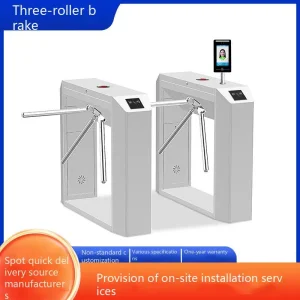
Factory Direct Smart Access Control Systems
Industrial cantilever gates, high-speed road barriers, and pedestrian access control hardware manufactured to global standards.

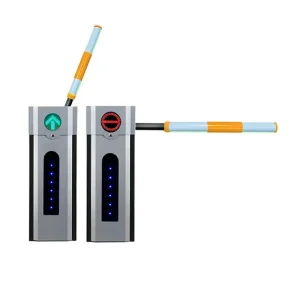
Engineering Architecture of CE Certified Trackless Sliding Gates
A comprehensive breakdown of structural mechanics, wind-load ratings, and safety certifications governing industrial cantilever gate manufacturing.
Trackless Cantilever Mechanics
Unlike conventional sliding doors relying on ground tracks susceptible to ice, gravel, and heavy vehicle deformation, modern trackless sliding doors use an overhead or bottom-anchored cantilever suspension beam. Engineered with counterbalance tail sections and dual-bearing roller carriage assemblies, these gates operate entirely suspended above road level, maintaining frictionless transit across spans exceeding 25 meters without road bed intrusion.
EN 13241-1 Industrial Gate Directives
CE Certification demands strict adhesion to European safety norms (EN 12453, EN 12445, and EN 12604). Our manufacturing protocols mandate dynamic obstacle detection via dual-frequency infrared safety curtains, integrated resistive safety edges (8.2 kΩ), fail-safe mechanical stops, and electronic motor torque monitoring that prevents vehicular entrapment or structural tipping under catastrophic failure scenarios.
Aerodynamic & Wind Load Classifications
High-span sliding gates are prone to significant lateral wind sheer. Our factory incorporates finite element analysis (FEA) to design high-tensile 6063-T6 aluminum and Q235B structural carbon steel door leaves. Engineered to meet EN 12424 Class 4 wind resistance ratings, these systems withstand hurricane-force wind velocities up to 130 km/h without structural deflection, rail derailment, or motor stalls.
Shenzhen Manufacturing Scale & Supply Chain Resilience
Combining complete vertical integration with intelligent robotic fabrication for enterprise-scale global distribution.
Vertical Hardware Integration
Operating an advanced 8,000 m² Shenzhen production facility, our manufacturing line integrates robotic laser cutting, precision CNC bending, automated continuous welding, and multi-stage anti-corrosion chemical treatment baths. By maintaining total internal oversight of structural framing, gearbox manufacturing, and electronic board assembly, we eliminate middleman markups and reduce supply-chain volatility.
Brushless DC & Variable Frequency Inverters
Every trackless sliding door engine is built with high-torque, industrial-grade Brushless DC (BLDC) motors or German-engineered frequency inverter drive units. This mechanical core enables continuous 100% duty-cycle operation (MTBF > 5 million cycles), soft-start and soft-stop acceleration ramps, and reduced thermal generation, delivering reliable performance across 24/7 commercial logistics ports.
OEM/ODM Customization Architecture
We provide full customization for global engineering contractors. Options range from custom clear opening widths (6m to 30m), modular picket vs. louvre skin configurations, customized RAL electrostatic powder-coatings (up to C5 marine-grade marine anti-corrosion standards), to custom controller firmware pre-configured for integration with regional access systems and localized voltage specifications (110V/220V/380V).
Enterprise Procurement Criteria: Mitigating Overseas Project Risk
Strategic engineering considerations for international developers, system integrators, and institutional project contractors.
Total Cost of Ownership (TCO) vs. Initial CapEx
Procuring low-cost, uncertified perimeter gates leads to recurring maintenance costs, road deformation downtime, and premature motor failure. By opting for trackless cantilever designs, procurement teams eliminate the civil engineering expenses of digging deep foundation trenches for ground rails, heating cables for sub-zero climates, and frequent rail debris clearing. Over a 10-year lifecycle, trackless systems offer an estimated 42% operational savings.
Local Regulatory Assurance & CE Documentation
Entering international commercial markets requires strict regulatory transparency. Our factory supplies comprehensive CE Declarations of Performance (DoP), factory test certificates, third-party lab safety test logs, electrical safety test certificates (LVD 2014/35/EU), and electromagnetic compatibility records (EMC 2014/30/EU). Every production batch undergoes documented dynamic impact load testing prior to factory dispatch.
Engineered for Severe Terrains & High-Security Perimeters
Trackless cantilever sliding doors solve complex access challenges where conventional wheeled or track gates cannot operate.
Sub-Zero & Harsh Winter Climates
In regions such as Northern Europe, Poland, and Canada, ground-track gates fail due to ice pack, snow build-up, and frost heave. Trackless sliding doors maintain an 80mm to 150mm ground clearance. Suspended mechanisms operate without physical ground contact, ensuring uninterrupted vehicular access throughout snowstorms without continuous snow-clearing operations.
Desert Sands & Industrial Logistics Corridors
In Middle Eastern desert projects (such as Qatar and UAE) or heavy logistics terminals with constant multi-ton vehicle throughput, blown sand, dust, and heavy truck axle loads crack and jam traditional ground tracks. Cantilever gates bypass surface conditions entirely, keeping bearings and drive units sealed inside an IP65 rated dust-proof cabinet enclosure.
Uneven, Sloped, or Unpaved Roadways
Civil infrastructure projects often require gates to be installed across sloped entrances, cross-falls, or unpaved temporary access roads. Cantilever trackless architecture anchors securely onto a single side-mounted reinforced concrete foundation pad, allowing the gate to extend across irregular roadways without extensive road-grading or leveling.
The AIoT Revolution in Autonomous Gate Operations
Transitioning from standalone mechanical barriers to edge-computed, cloud-synchronized smart perimeter defense portals.
Predictive Telemetry & Remote Diagnostics
Next-generation trackless sliding door controllers feature integrated IoT telemetry. By monitoring drive motor amperage profiles, cycle times, brake friction coefficients, and ambient temperatures, the system warns facility maintenance managers of mechanical wear before a field breakdown occurs.
Edge LPR & Multi-Factor Verification
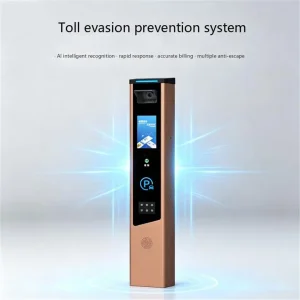
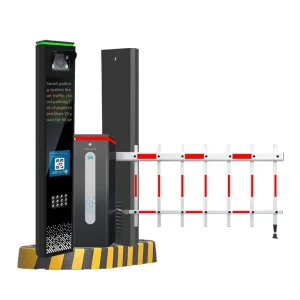
Seamlessly integrated with high-speed ANPR/LPR (License Plate Recognition) cameras, trackless industrial doors can open automatically upon dynamic plate validation. Integrated optical sensors and radar verify vehicle profiles, allowing continuous free-flow passage for authorized fleets while blocking unauthorized access.
Unattended Payment & Unified Access
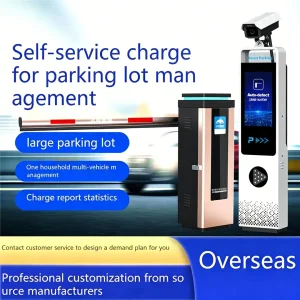
Perimeter gates and parking access solutions link back to centralized platforms supporting cloud-based revenue validation. Whether managing distribution logistics yards or commercial business hubs, the gate ecosystem supports cross-border payment modules, RFID tracking, and digital ledger auditing across 100+ countries.
Industrial Cantilever vs Ground-Track Technical Comparison
Comprehensive engineering matrix evaluating structural properties, operational parameters, and deployment limitations.
| Performance Parameter | CE Certified Trackless Cantilever Gate | Standard Wheeled Ground-Track Gate | Engineering Impact / Advantage |
|---|---|---|---|
| Civil Roadwork Requirements | Minimal Single side concrete anchor pad | Continuous steel track entrenched across roadway | Cuts civil installation time and road closure costs by 70%. |
| Operating Clearance | 80 mm - 150 mm suspension clearance | 0 mm (rests directly on recessed ground track) | Immune to road surface deformation, snow, ice, and sand buildup. |
| Maximum Clear Opening | Up to 15 m (Single) / 30 m (Dual cantilever) | Up to 20 m (limited by track deflection) | Supports heavy cargo and logistics vehicle access. |
| Drive Motor Architecture | Integrated BLDC / Heavy-Duty AC Inverter (100% Duty) | Intermittent AC gear motor (50% Duty cycle) | Continuous operation under intensive logistics traffic. |
| Safety Standard Compliance | Fully compliant with EN 12453 / EN 12445 / CE | Variable / Basic limit switches | Redundant infrared beams and safety pressure edges prevent vehicle trapping. |
| Lifecycle Maintenance | Enclosed self-lubricating sealed bearing rollers | Exposed wheels prone to gravel and grit wear | Reduces scheduled maintenance and operating costs over long deployments. |
Frequently Asked Questions: Global Procurement & Integration
Essential answers for overseas contractors, structural engineers, and systems procurement specialists.
What documentation certifies your trackless gates for European infrastructure?
Every commercial door and drive assembly includes a formal Declaration of Conformity (DoC) and CE marking corresponding to EU Machinery Directive 2006/42/EC, Construction Products Regulation (EU) No 305/2011, and harmonized standard EN 13241-1. Complete structural calculation books and electrical test reports are provided with every order.
How does the counterbalance system handle high wind zones?
The gate uses an extended counterbalance tail (typically 30% to 40% of the clear opening span) anchored via two heavy-duty multi-bearing roller carriages secured to an engineered concrete footer. The beam cross-section and guide frame withstand lateral wind overturning moments up to EN 12424 Class 4.
Can the factory pre-wire controllers for third-party access control platforms?
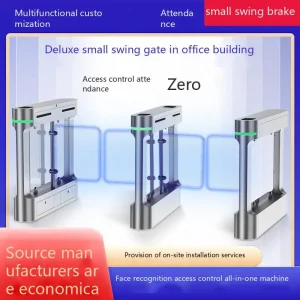
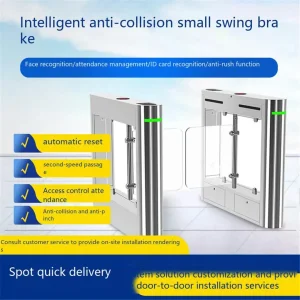
Yes. Our micro-controllers and frequency inverters feature dry-contact relays, RS-485 serial ports, and standard Wiegand/TCP/IP communication bridges. They integrate directly with third-party LPR cameras, long-range RFID readers, facial recognition speed-gates, and building management systems (BMS).
What is the factory lead time and global shipping format?
Standard architectural configurations are manufactured and factory-tested within 15–20 business days. For global maritime shipping, gates with spans exceeding standard 40-foot container lengths (11.8m) are engineered in modular sections with internal alignment sleeves, ready for bolted field assembly.
Enterprise Entrance Automation Hardware
Reliable pedestrian gates, high-definition optical recognition systems, and smart urban parking products available directly from our manufacturing floor.