
Enterprise Access Control Hardware & Integrated Security Systems
Explore heavy-duty vehicular and pedestrian entrance automation systems engineered for continuous 24/7 commercial duty and tested across diverse environments globally.
Global Enterprise Procurement Dynamics for Pedestrian Swing Gates
Strategic analysis of architectural access trends, tailgating mitigation, lifecycle ownership economics, and the shift from mechanical tripods to smart optical swing turnstiles.
Tailgating & Anti-Intrusion Precision
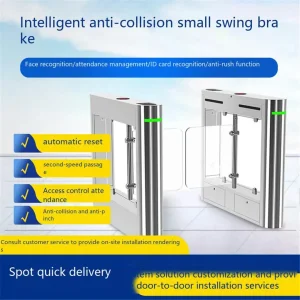
Modern commercial infrastructure demands rigorous perimeter integrity without inducing lobby bottleneck friction. Tier-1 enterprise facilities utilize multi-zone infrared optical matrices paired with dynamic algorithmic passage profiling to distinguish between authorized badge holders, trailing unauthorized pedestrians, and roll-on luggage.
- Up to 24 pairs of pulsed through-beam IR sensors
- Sub-100ms algorithmic tailgating detection
- Intrusion directionality & anti-reverse locking
Brushless DC & Servo Reliability
The transition from mechanical friction clutches to direct-drive permanent magnet brushless DC (BLDC) and planetary servo drive systems delivers an unprecedented Mean Cycles Between Failures (MCBF) exceeding 10,000,000 cycles. This drastically lowers planned downtime and eliminates grease contamination in cleanroom environments.
- Direct drive with 24-bit digital absolute encoder
- Adaptive closed-loop motion dampening
- Ultra-quiet acoustics under 48 dBA in operation
Universal ADA Passage Accessibility
Global building codes, including the Americans with Disabilities Act (ADA Title III) and European accessibility norms, necessitate wheelchair and bulky equipment passage widths of 900mm to 1000mm. Swing gates achieve this without sacrificing structural stiffness or compromising motor acceleration response.
- Standard 600mm or extended 900-1000mm lane width
- Impact-resistant acrylic or 10mm toughened glass
- Synchronized dual-barrier wide-lane control
Information Gain Note: True Total Cost of Ownership (TCO) vs. Initial Capital Outlay
Procurement teams prioritizing sub-$800 low-tier swing gates routinely experience motor failure, encoder drift, and safety sensor degradation within 14 to 18 months under medium commercial throughput (1,500 passages/day). Conversely, industrial CE-certified swing gates utilizing brushless servo motors and IP65 encapsulated sensor optics demonstrate a 10-year service life with maintenance intervals restricted to routine optical cleaning and drive belt tension verification.
CE Certification Framework & International Safety Directives
Understanding the statutory compliance benchmarks required for commercial installation across the European Union, the United Kingdom, and international jurisdictions.
Machinery Directive 2006/42/EC & EN 16005 Standards
Pedestrian swing turnstiles are legally classified as power-operated pedestrian doorsets under European Union directives. To obtain valid CE marking and UKCA conformity, factories must satisfy strict mechanical and functional safety parameters:
- EN 16005 Impact Force Limitation: Maximum closing force must not exceed 150 N static and 400 N dynamic; barriers must automatically reverse within 50ms upon contacting an obstacle.
- Anti-Entrapment Finger Guards: The gap between the rotating barrier and the pedestal housing must remain below 8mm or exceed 25mm throughout the entire 180° swing radius to eliminate shearing risks.
- Fire Emergency Egress (Fail-Safe Breakout): Integrated dry-contact fire alarm relays trigger immediate, power-loss freewheeling. Barriers swing outward freely with under 50 N of manual pressure.
Electromagnetic Compatibility (EMC) & Low Voltage (LVD) Directives
Enterprise access lanes operate in dense electrical environments surrounded by UHF RFID readers, biometric facial scanners, mobile telemetry transmitters, and building management networks:
- EMC Directive 2014/30/EU: Validated immunity against radio frequency interference, electrostatic discharge (up to 8 kV contact, 15 kV air discharge), and surge suppression (EN 61000-6-2 / EN 61000-6-4).
- Low Voltage Directive 2014/35/EU: Internal primary bus operating on safe extra-low voltage (24V DC / 36V DC), isolating users from dangerous mains electrical currents.
- Factory Production Control (FPC): Direct factory traceability with serial numbered chassis, verified test certificates, and DoC (Declaration of Conformity) documentation.
Technical Specification & Drive Mechanism Comparison Matrix
A rigorous engineering audit comparing traditional stepper systems against high-performance brushless DC and PMSM servo drive technologies.
| Specification Parameter | Legacy Stepper Turnstiles | Brushless DC (BLDC) Gates | Permanent Magnet Servo (PMSM) |
|---|---|---|---|
| Mean Cycles Between Failures (MCBF) | 1,500,000 to 3,000,000 cycles | 5,000,000 to 8,000,000 cycles | 10,000,000+ cycles |
| Opening / Closing Transit Velocity | 0.8s – 1.2s per cycle | 0.4s – 0.6s per cycle | 0.25s – 0.4s per cycle |
| Throughput Capacity (Pedestrians/Min) | 20 – 25 persons / min | 35 – 45 persons / min | 50 – 60 persons / min |
| Positional Feedback & Sensing | Optical slot limit switches | 12-bit magnetic incremental | 24-bit absolute rotary encoder |
| Acoustic Decibel Rating (Operation) | 58 – 65 dBA | 48 – 52 dBA | < 45 dBA (Whisper Quiet) |
| Power Consumption (Active / Standby) | 80W / 25W | 50W / 12W | 35W / 6W (Eco Standby) |
| Anti-Impact Mechanical Clutch | Rigid shear pin / None | Slipping magnetic clutch | Torque-monitoring auto release |
| CE EN 16005 Dynamic Force Reversal | Manual reset required | Electronic reverse trigger | Adaptive dynamic micro-sensing |
Enterprise Macro-Industry Architectural Solutions
Delivering unified physical identity and access management across four primary commercial, industrial, and high-security sectors.
Class-A Corporate Towers
Aesthetic speed gates featuring 10mm crystal-clear glass, slim 110mm pedestals, and seamless destination dispatch elevator integration. Supports mobile Apple Wallet NFC, HID Origo, and QR visitor invites.
Logistics & Industrial Hubs
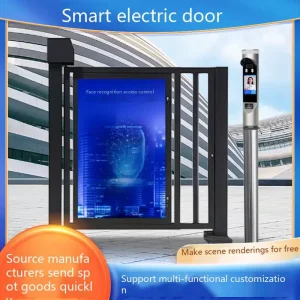
SUS316 stainless-steel outdoor enclosures rated IP65 with built-in turnstile canopies, ESD static test terminals, facial biometric thermometers, and synchronized perimeter barrier gates for vehicle/pedestrian separation.
Multi-Modal Transit Centers
Heavy duty bi-directional swing lanes deployed in metro and rail platforms. Handles high throughput up to 60 passengers per minute with barcode reading engines scanning digital tickets under 150ms.
Sports Arenas & Gyms
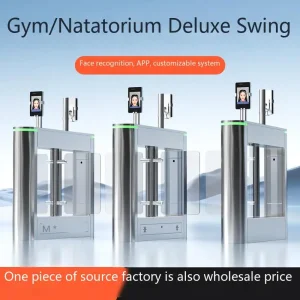
Automated cloud-managed member access supporting RFID wristbands, token validators, and anti-climb overhead sensors to eliminate unauthorized admissions during high-capacity sporting and entertainment events.
Factory-Direct Pricelist & OEM Procurement Quotation Guidelines
Comprehensive cost breakdown matrix based on manufacturing volumes, materials customization (SUS304 vs. SUS316), and drive tier configurations.
| Pedestrian Swing Gate Series | Drive Core & Sensor Array | Sample Tier (1-5 Sets) | Project Tier (6-20 Sets) | Container Tier (20+ Sets / OEM) |
|---|---|---|---|---|
| Slim Architectural Speed Gate (AR-SW01) SUS304 Brushed, 10mm Tempered Glass, 600mm Lane |
DC Brushless + 8 Pairs IR Optics | $1,150 – $1,350 / Lane | $880 – $990 / Lane | $720 – $790 / Lane (FOB) |
| Extended ADA Wheelchair Speed Gate (AR-SW01-ADA) SUS304 Brushed, High-Torque Servo, 900mm Lane |
PMSM Servo + 12 Pairs IR Optics | $1,380 – $1,550 / Lane | $1,050 – $1,180 / Lane | $890 – $960 / Lane (FOB) |
| Heavy-Duty Outdoor Industrial Swing Gate (AR-SW-IND) SUS316 Marine Grade, IP65 Sealed, Dual High Barriers |
Planetary Servo + 16 Pairs Dual Optics | $1,750 – $1,980 / Lane | $1,350 – $1,480 / Lane | $1,120 – $1,250 / Lane (FOB) |
| Louver / Advertising Swing Gate Integrated (AR-GGD04) Chassis Integrated LED Display & Louver Barrier |
Torque Motor + Vehicle/Pedestrian Dual Sensor | $1,420 – $1,650 / Set | $1,100 – $1,240 / Set | $920 – $1,020 / Set (FOB) |
OEM / ODM Engineering Customization Options
Volume buyers can customize: (1) Pedestal housing finish (PVD Titanium Black, Rose Gold, Matte Bronze, or RAL custom powder coating); (2) Sensor arrays expanded up to 24 pairs for zero-tolerance tailgating; (3) Reader integration modules pre-milled for Suprema, HID, Idemia, or STid readers; (4) Private-labeled acrylic barriers with laser-etched enterprise brand marks and illuminated LED chasing strips.
Complementary Smart Parking & Perimeter Hardware
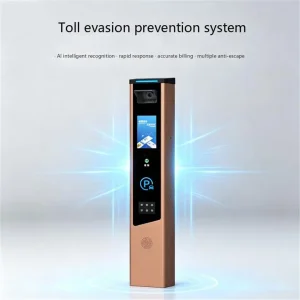
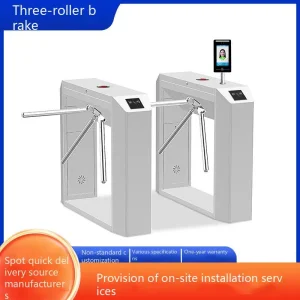
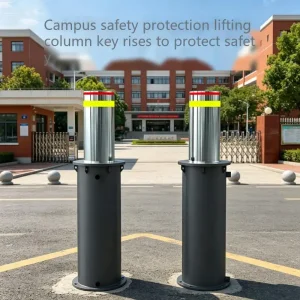
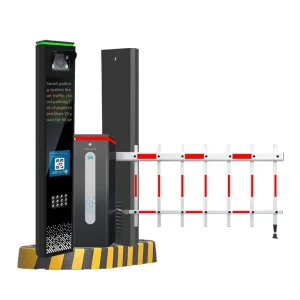
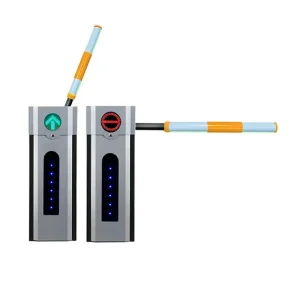
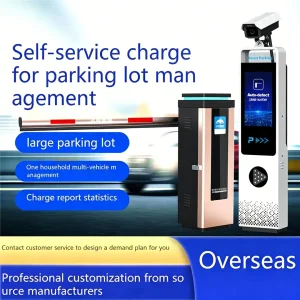
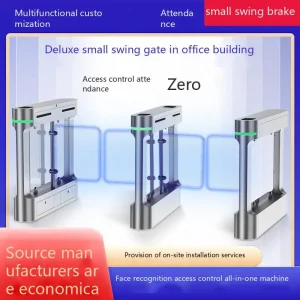
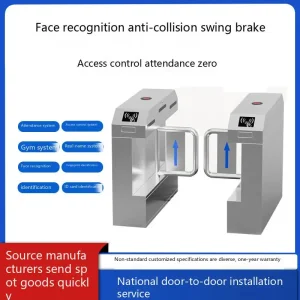
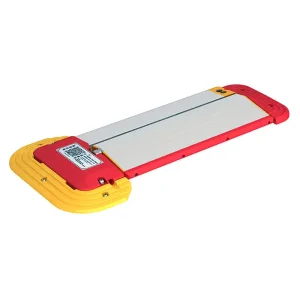
Complete perimeter management demands tight integration between pedestrian speed lanes, hydraulic rising bollards, and automated vehicular barrier gates.

Technical Roadmap & Future Outlook (2026–2035)
How edge computing, Time-of-Flight (ToF) 3D vision, and contactless Ultra-Wideband (UWB) credentials are redefining pedestrian speed lane capabilities.
Edge AI & 3D LiDAR Optical Curtains
Traditional discrete infrared beams are yielding to integrated stereoscopic ToF (Time-of-Flight) cameras and micro-LiDAR sensors embedded along the lane canopy. Edge neural networks render real-time point-cloud body volume maps, completely eliminating false alarms triggered by backpacks, service animals, or trailing roller luggage.
IoT Predictive Maintenance Telemetry
Next-generation swing gate logic controllers integrate dual MQTT and BACnet IP protocols to report operational health telemetry directly to cloud facility suites. Accelerometers detect gearbox harmonic vibrations, torque rise signatures, and thermal fluctuations, triggering preventative servicing long before unexpected lane lockouts occur.
UWB & Truly Frictionless Passage
Ultra-Wideband (UWB) positioning within authorized employee smartphones facilitates verified, hands-free passage. Gates calculate pedestrian approach vectors, verify spatial credentials within 10cm accuracy, and open barriers ahead of the user without necessitating physical stopping, badge presentation, or face positioning.
Frequently Asked Questions (FAQ)
In-depth responses authored by access control hardware engineers to resolve common technical, compliance, and integration inquiries.
What is the explicit difference between CE-certified swing gates and standard uncertified turnstiles?
CE certification confirms audited compliance with European statutory Directives: Machinery Directive (2006/42/EC), Low Voltage Directive (2014/35/EU), and EMC Directive (2014/30/EU). Certified units adhere to EN 16005 kinetic energy limitation rules, requiring closing force to stay beneath 150 N with immediate obstacle reversal. Non-certified turnstiles frequently use high-torque motors lacking dynamic current monitoring, introducing severe pinch and crushing hazards.
How does the gate respond during a facility fire alarm or total power outage?
Our gates utilize an electro-mechanical fail-safe architecture. When the dry-contact fire alarm input is energized, or when utility 110V/230V AC power drops, internal electromagnetic clutches disengage immediately. Supercapacitor reservoirs or mechanical counterbalances automatically swing the barriers into the open position along the egress path, satisfying NFPA 101 Life Safety Code and European EN 13637 emergency building escape standards.
Can third-party access controllers (Wiegand, OSDP, IP) integrate with your mainboards?
Yes. The central microprocessor control board features multi-protocol interfaces including standardized Wiegand 26/34/66-bit inputs, RS485 (OSDP v2 encrypted), relay contact trigger loops, and direct TCP/IP network sockets. Third-party readers—such as barcode/QR scanners, facial recognition biometric terminals, RFID card readers, and coin accumulators—can be directly surface-mounted or sub-flush integrated.
What passage clear width is needed to satisfy ADA wheelchair accessibility guidelines?
Under ADA Title III regulations, an accessible lane must maintain a minimum clear opening width of 32 inches (813mm), with 36 inches (914mm) being the international commercial standard. Our extended-arm swing gates provide an adjustable 900mm to 1000mm clear passage, allowing unrestricted passage for electric wheelchairs, rollators, and bulky cargo shipments.
Can pedestrian swing turnstiles be installed outdoors in rain and sub-zero climates?
Standard indoor units feature SUS304 brushed stainless steel. For outdoor or perimeter installations, we construct the pedestal chassis from AISI 316 marine-grade stainless steel with internal IP65 electronic encapsulation, specialized conformal PCB coatings, silicone door seals, and internal thermostatically regulated heating strips operating reliably down to -30°C and up to +65°C.
What is the standard production lead time and factory quality inspection workflow?
Standard configurations carry a production cycle of 7 to 10 working days; customized OEM orders (RAL coating, bespoke dimensions) require 15 to 20 days. Every unit completes a mandatory 72-hour continuous aging cycle in our factory, comprising 10,000 automated cycles with mechanical torque curve validation, optical sensor alignment, and high-voltage dielectric withstand checks.