Featured Biometric & Physical Access Systems
Industrial-grade vehicle barrier gates, biometric speed gates, and smart perimeter locks engineered for zero-trust physical access architectures.

The Democratization of Biometric Verification: From Premium Defense to High-Volume Commercial Utility
Understanding how advancements in semiconductor fabrication, optical prism coatings, and embedded neural networks enable tier-one biometric security within budget-friendly capex parameters.
Sensor Topologies & Optical Precision
Historical barrier-to-entry constraints were dictated by optical sensor fabrication costs. Contemporary 500 DPI scratch-resistant optical prisms combined with CMOS image sensors now deliver military-grade verification at commercial scale. By optimizing total internal reflection (TIR) metrics and anti-latent image algorithms, modern budget fingerprint modules prevent residual print spoofing without costly multispectral polarization arrays.
Edge Processing & Matching Engine
Legacy systems relied on centralized controller servers, introducing significant round-trip latency and costly networking hardware. Today's budget-friendly standalone access controllers embed ARM Cortex-A and dual-core RISC-V microprocessors directly on the sensor breakout board. This local compute architecture achieves 1:N fingerprint database matching (<10,000 templates) in under 0.25 seconds with a False Acceptance Rate (FAR) under 0.0001%.
Zero-Trust Network Orchestration
Cost optimization no longer entails protocol vulnerability. Enterprise edge devices support standard OSDP v2.2 (Open Supervised Device Protocol) featuring AES-128 cryptographic channel encryption over RS-485 pairs, fully replacing insecure legacy Wiegand data buses. Direct TCP/IP and MQTT webhooks allow seamless synchronization with cloud directory systems such as Microsoft Entra ID without middle-tier enterprise licensing fees.
Strategic Procurement Framework: TCO Matrix & Direct Factory Economics
A quantitative analysis contrasting distributor markups against factory-direct OEM/ODM engagements for facility directors, EPC contractors, and master systems integrators.
| Evaluation Parameter | Tier-1 Western Conglomerates | Regional White-Label Resellers | Shenzhen Direct Manufacturing (Anrui) |
|---|---|---|---|
| Hardware Unit Capex | $450 – $1,200 per reader terminal | $220 – $480 per reader terminal | $45 – $130 (BOM Factory Cost) |
| Recurring Cloud/Seat Licensing | Mandatory $15 – $45 / user / yr | Optional $5 – $12 / user / yr | $0 Free On-Prem / Open REST API |
| Protocol Interoperability | Proprietary Ecosystem Lock-in | Standard Wiegand 26/34 | OSDP v2.2, Wiegand, TCP/IP, MQTT |
| Sensor MTBF (Mean Time Between Failures) | > 5,000,000 read cycles | ~ 1,500,000 read cycles | > 3,500,000 read cycles |
| Custom Mechanical/Firmware Tooling | Cost-prohibitive NRE ($50k+) | Not Supported | Rapid Turnaround (CAD/CAM OEM <14 Days) |
Elimination of the Multi-Tier Reseller Markup
Traditional commercial security distribution chains involve regional master distributors, local wholesalers, and installation subcontractors, each layering 20% to 35% margins onto the physical bill of materials. Direct sourcing from an 8,000 m² Shenzhen production plant reduces net procurement expenses by up to 60%, redirecting capital expenditure toward enterprise-wide perimeter redundancy and structural build quality.
Low-Friction Maintenance & Universal Spares
Budget systems historically suffered from brittle plastic casings and proprietary ribbon connectors. Modern factory-direct biometric readers leverage standardized IP65 silicone seals, IK08 zinc alloy chassis, and universal RJ45/terminal blocks. Field technicians replace or calibrate worn modules within 10 minutes without requiring proprietary OEM commissioning licenses.
Integrated Perimeter Framework: Orchestrating Biometric Sensors with Physical Barriers
True physical access security requires flawless low-latency synchronization between biometric verification endpoints, automated swing speed gates, intelligent road barrier booms, and centralized perimeter management platforms.
Pedestrian Speed Gate Integration
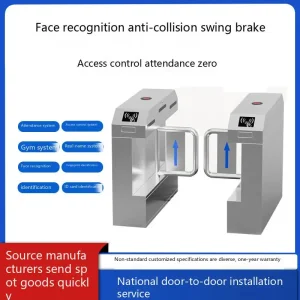
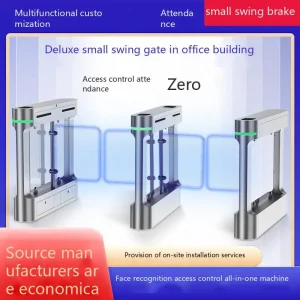
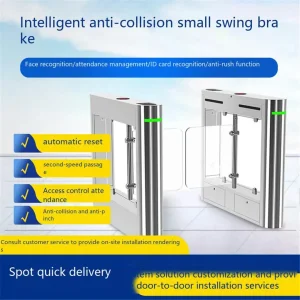
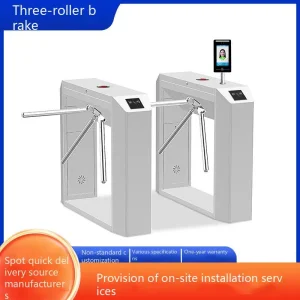
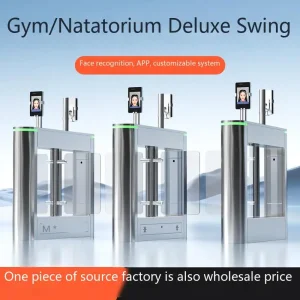
Commercial lobbies require rapid personnel clearance without bottlenecks. High-speed optical swing barriers integrate embedded fingerprint reader pedestals flush within the SUS304 brushed stainless steel architecture. When authenticated, dry-contact relays trigger brushless DC (BLDC) servo motors to open barriers in 0.3 seconds. Integrated infrared safety sensors dynamically prevent tailgating and pinch injuries.
Commercial Vehicle Lane & Boom Gate Dual-Verification
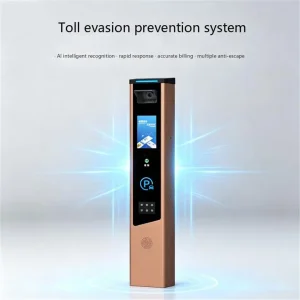
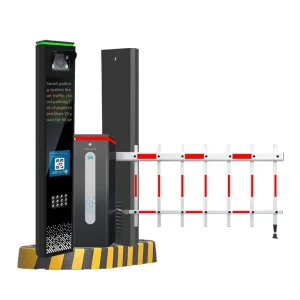
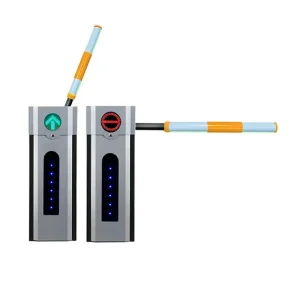
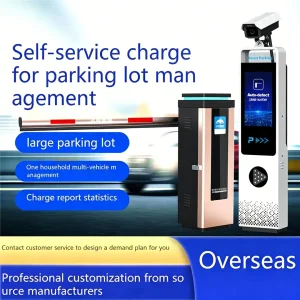
In industrial logistics yards and secure gated corporate centers, automatic boom barrier gates operate in concert with LPR (License Plate Recognition) cameras and driver-side biometric verification pillars. Authorized transport personnel present a quick fingerprint verification at the all-weather roadside pedestal to override security locks, ensuring non-repudiation during hazardous material or bonded cargo transit.
Anti-Hostile Perimeter & Hydraulic Bollards
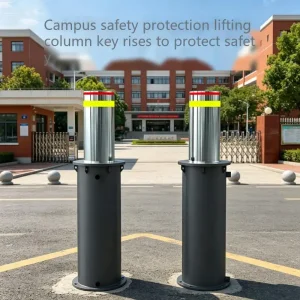
For critical municipal facilities, financial data hubs, and diplomatic quarters, biometric access controllers command heavy-duty rising hydraulic bollards. K4/K12 impact-certified bollards remain deployed until mutual two-factor authentication (Biometric Fingerprint + Encrypted RFID Desfire EV3) is validated by the local edge controller, retracting flush with the pavement in under 2.5 seconds.
Biometric Compliance: GDPR Article 9, ISO/IEC 19794, and Template Security
Enterprise deployments require strict adherence to global biometric data privacy frameworks. Budget-friendly systems must never compromise legal compliance or personal data sovereignty.
Irreversible Template Hashing
Raw fingerprint bitmap images are never stored or transmitted across communication buses. On-chip mathematical extractors translate ridge characteristics and minutiae points into irreversible, encrypted proprietary binary templates (SHA-256 / AES-256 hashed). Even in the event of an adversary capturing controller storage, the biometric fingerprint cannot be reverse-engineered or reconstituted.
GDPR Article 9 & CCPA Compliance
Under European GDPR Article 9 and California CCPA regulations, biometric identifiers are designated as special-category sensitive personal data. Modern budget access firmware supports localized "Right to Erasure" automated endpoints, zero-knowledge cloud sync, and on-card template storage (Match-On-Card architecture), ensuring employee consent models remain audit-compliant.
Physical Tamper & Anti-Sniffing Bus
Controllers feature optical tamper sensors and micro-switch tripwires that instantly wipe local volatile cryptographic keys if a terminal is forcibly detached from its backplate. Paired with OSDP v2 Secure Channel encryption, physical intrusion vectors such as bus-sniffing or man-in-the-middle replay attacks are rendered mathematically inert.
Technology Roadmap (2026–2030): Multi-Modal Fusion, Live-Tissue Edge AI, and Matter PACS
The evolutionary trajectory of cost-effective commercial access control points toward seamless multi-modal sensor fusion, on-device anti-spoof AI, and universal IoT connectivity.
1. Multi-Modal Palm Vein & Touchless Fingerprint
While capacitive and optical contact sensors dominate current price-to-performance metrics, high-speed near-infrared (NIR) touchless fingerprint and subdermal palm vein sensors are rapidly descending the cost curve. By capturing subcutaneous vascular patterns unaffected by surface skin dirt or moisture, next-generation terminals offer hygienic, contact-free passage without enterprise-tier price tags.
2. Edge Neural Networks for Liveness Detection
Adversarial spoofing techniques involving conductive silicone, 2D printed latex, and gelatin impressions are rendered obsolete by deep learning convolutional neural networks (CNNs) running locally on sub-dollar NPU chips. Analyzing micro-pulse blood flow patterns and light absorption characteristics in real-time, edge AI validates live human tissue with 99.98% certainty.
3. Convergence with Smart Matter & Zero-Trust Mesh
The unification of smart commercial spaces under universal protocols like Matter and Thread enables physical turnstiles, biometric wall readers, and building automation controllers to interoperate seamlessly. Access control controllers will operate as zero-trust authentication nodes within decentralized software-defined perimeters (SDP), delivering continuous enterprise auditability.
Frequently Asked Questions: B2B Sourcing, Installation & Integration
Essential technical insights for system architects, commercial property developers, and overseas procurement agents evaluating cost-effective access hardware.
Cost-efficient modern controllers utilize high-resolution 500 DPI optical sensors combined with optimized minutiae-matching algorithms implemented directly in firmware. By extracting 30 to 60 distinct minutiae coordinate vectors per template and running matching through hardware-accelerated DSPs, modern budget units consistently deliver a False Acceptance Rate (FAR) under 0.0001% and False Rejection Rate (FRR) under 0.01%, mirroring the security performance of legacy enterprise hardware.
Yes. All Anrui biometric reader terminals and access control boards are engineered with universal interfacing capabilities. They feature standard OSDP v2.2, Wiegand 26/34 output, RS485 communication, dry-contact relay outputs, and Ethernet TCP/IP connectivity. Comprehensive SDKs, API documentation, and sample code (Python, C#, Java) are supplied free of charge, allowing straightforward integration into third-party payroll, HRMS, and enterprise building management systems.
Industrial and perimeter-grade units feature hermetically sealed optical blocks with IP65-rated ingress protection, conformal-coated internal PCB assemblies to prevent condensation short-circuits, and operating temperature tolerances ranging from -25°C to +65°C. For extreme exposure zones such as tropical maritime ports (e.g., Philippines) or desert facilities (e.g., Qatar), stainless steel grade SUS316 housings and sun-shield enclosures are optionally configurable.
Standard production runs for catalogue models range between 5 and 12 business days depending on volume. For OEM/ODM orders involving client logo silkscreening, customized firmware welcome screens, bespoke bracket dimensions, or unique relay timing scripts, prototyping requires 7 business days, with mass manufacturing completed within 15–20 days supported by international sea or express air freight delivery across 80+ countries.
Factory-Direct Turnstiles & Access Automation In Sales
Direct from our Shenzhen 8,000 m² plant: high-throughput turnstiles, heavy-duty boom gates, and integrated license plate recognition terminals.